
In India's rapidly evolving construction landscape, the foundational material that physically builds our nation's progress is concrete. From residential homes to mega-infrastructure projects, understanding concrete is essential.
Here is a comprehensive guide on the science, application, and future of concrete in the Indian construction industry.
1) What is Concrete?
Concrete is a versatile, durable, and highly resilient composite construction material. It is primarily composed of three main ingredients: cement (the binding agent), water, and aggregates (such as fine sand and coarse crushed stone or gravel).
When water is mixed with cement, a chemical reaction known as hydration occurs. This reaction produces a calcium silicate hydrate (C-S-H) gel that acts as a strong matrix, binding the aggregates together to form a rock-like substance. Because fresh concrete is highly plastic and can be molded into virtually any shape, it is the backbone of modern infrastructure, utilized extensively in residential and commercial buildings, rigid pavements, bridges, and ports. Depending on the application, concrete can be reinforced with steel (RCC) for tensile strength, precast off-site for rapid construction, or formulated as High-Performance Concrete (HPC) to withstand extreme environmental conditions.
2) Factors Affecting the Strength and Performance of Concrete
The long-term durability and structural integrity of concrete depend on several critical parameters:
Water-Cement (W/C) Ratio: This is the single most important factor determining concrete strength. A lower water-to-cement ratio results in higher compressive strength, reduced permeability, and greater durability. IS 456:2000 strictly mandates maximum W/C ratios based on environmental exposure, ranging from 0.55 for mild exposure to 0.40 for extreme coastal conditions.
Type of Cements: The Indian market relies on several types of cement. Ordinary Portland Cement (OPC 43 and 53 grades) is standard for rapid strength gain. However, Portland Pozzolana Cement (PPC) and Portland Slag Cement (PSC) are highly preferred for their resistance to chemical attacks and lower heat of hydration, making them ideal for mass pours and coastal structures. Recent updates to IS 456 also encourage the use of Composite Cements and Portland Calcined Clay Limestone Cement.
The Curing Process: Curing maintains adequate moisture and temperature within the concrete so that hydration can continue uninterrupted. Standard curing takes 28 days to achieve maximum characteristic compressive strength. Common methods in India include moist curing (ponding water or using wet hessian cloths) and membrane curing (applying chemical barriers to seal in moisture).
Aggregate Quality and Grading: Making up 60–80% of the concrete's volume, aggregates significantly influence mix workability and final strength. Using properly graded sand (like Zone II M-sand) and angular coarse aggregates ensures optimum void filling.
Weather Conditions: India's diverse climate heavily impacts fresh concrete. Hot weather accelerates setting time, requiring the use of retarding admixtures. Conversely, pouring concrete in wet monsoon weather can dilute the cement paste if the mix isn't adjusted and protected.
3) Best Practices in Using Concrete and Their Types/Grades
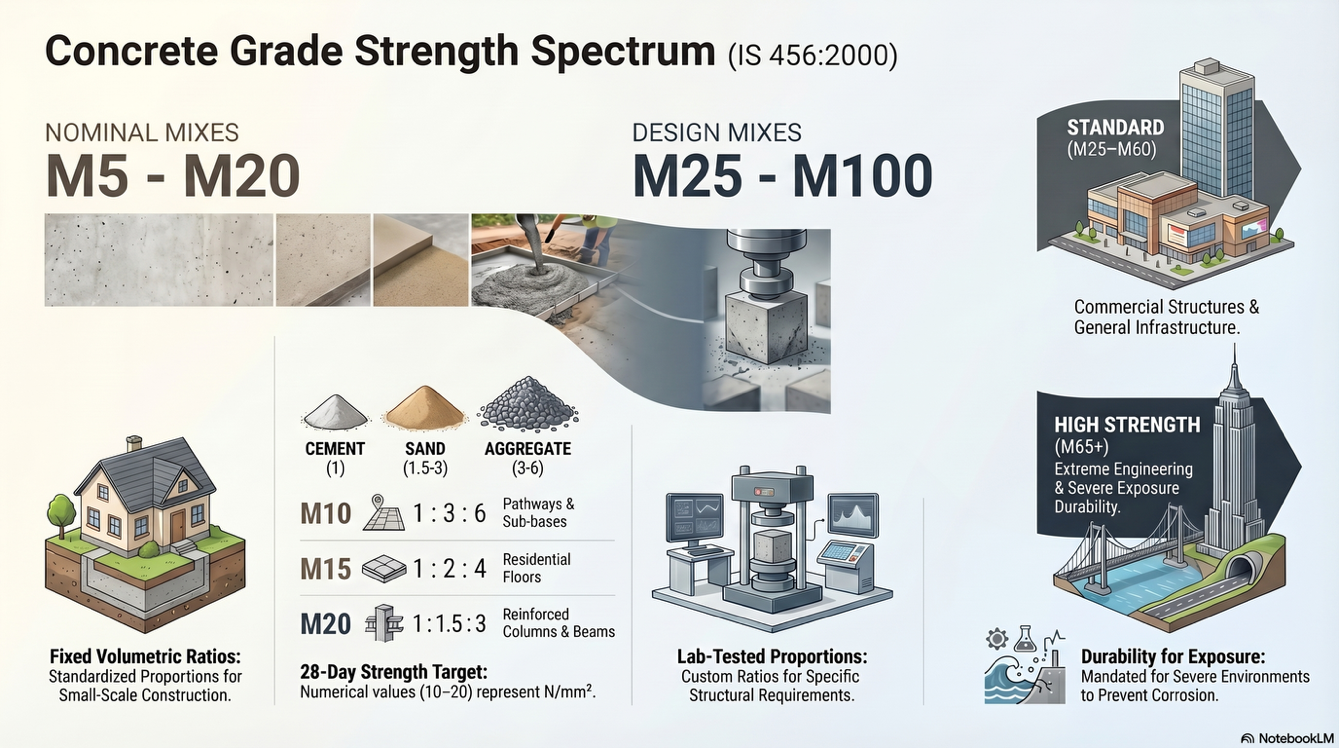
In India, concrete is classified by its characteristic 28-day compressive strength (in MPa or N/mm²), denoted by the letter 'M' for Mix. Under the revised IS 456:2000 standards, concrete is categorized into Ordinary (M10–M20), Standard (M25–M60), and High Strength (M65–M100).
There are two primary approaches to proportioning concrete:
Nominal Mix: These are predetermined volumetric ratios strictly limited to simpler, low-load applications (M20 and below).
Design Mix: For any structural work requiring M25 grade or higher, IS 10262:2019 mandates a scientifically tested laboratory design mix tailored to exact site conditions and material properties.
Common Grades and Construction Applications:
M15 (Ratio 1:2:4): Used primarily for Plain Cement Concrete (PCC), leveling courses, and floor blinding.
M20 (Ratio 1:1.5:3): The minimum grade permissible for Reinforced Cement Concrete (RCC) in mild exposures. Ideal for residential domestic floors, basic columns, slabs, and foundations.
M25 (Ratio 1:1:2): Used heavily in standard commercial buildings, heavy footings, and multi-story RCC frameworks.
M30 to M40 (Design Mix): Essential for roads, bridges, and severe environmental exposures. M40 is typically used for heavy infrastructure and chemical-resistant structures.
M50 to M100 (Design Mix): Ultra-high-strength concrete utilized in megaprojects like high-rise skyscrapers, nuclear power plants, and marine infrastructure (e.g., Mumbai Coastal Road).
Best Practices: Always batch by weight rather than volume for critical structures. Ensure proper compaction using mechanical vibrators to eliminate air pockets, and strictly adhere to the designated exposure class limitations for cement content and W/C ratio.
4) Common Mistakes in Making Concrete and its Application
Even with premium materials, poor site practices can lead to structural failure. Common mistakes include:
Adding Excess Water On-Site: Masons often add extra water to make the concrete easier to pour and work with. This drastically alters the water-cement ratio, leading to severe strength reduction, segregation, bleeding, and eventual cracking.
Ignoring Proper Curing: Neglecting the 28-day curing process, or allowing the concrete to dry out rapidly under the hot sun, stops the hydration process prematurely. This causes shrinkage cracks and heavily compromises durability.
Using Nominal Mixes for Heavy Loads: Relying on basic 1:2:4 or 1:1.5:3 volumetric nominal mixes for high-rise or heavily loaded commercial structures instead of investing in a proper, lab-tested Design Mix.
Poor Compaction: Failing to use vibrators during pouring leaves trapped air voids (honeycombing) inside columns and beams, creating weak points in the structure.
Improper Wet Weather Pouring: Failing to adjust the water-cement ratio during monsoons or not covering fresh concrete with tarps can wash away the cement paste, ruining the surface and structural integrity.
5) Innovations and Sustainability in Concrete
The cement industry is a major contributor to global carbon emissions, but the Indian construction sector is rapidly transitioning toward green, sustainable practices.
Supplementary Cementitious Materials (SCMs): To decarbonize concrete, partial replacement of OPC with industrial by-products is now standard practice. Materials like Fly Ash (from thermal plants), GGBS (Ground Granulated Blast Furnace Slag from steel mills), and Silica Fume not only reduce CO₂ emissions but also drastically improve the concrete's resistance to chemical attacks and permeability. For example, the Bengaluru International Airport utilized 40% GGBS to significantly reduce its carbon footprint.
Advanced Chemical Admixtures: Polycarboxylate Ether (PCE)-based superplasticizers are revolutionizing concrete placement. They allow for massive reductions in water content while maintaining a highly fluid, self-compacting mix, enabling the pumping of concrete hundreds of meters into the air for skyscraper construction.
Circularity and Recycling: Innovations include using recycled concrete aggregates from demolished structures to conserve natural stone and reduce landfill waste, paving the way for a circular construction economy.
Written by
ConstroMat Desk
Expert contributor at ConstroMat, sharing insights on construction materials, industry trends, and best practices.
View all posts