
You're building a house. Or maybe a Bridgeor Highways. Either way, thousands of items are moving through your project — cement bags, steel bars, pipes, tiles, sand, bricks. Each one has a price, a tax rate, and a paper trail.
How does the Government, Supplier and Customers actually keep track of all these different items?
What Is an HSN Code? (And Why Should You Care?)
HSN stands for Harmonized System of Nomenclature.
In simple Hindi terms:
Harmonized (हार्मोनाइज्ड) = एक जैसा, एक समान System (सिस्टम) = व्यवस्था Nomenclature (नोमेनक्लेचर) = नामकरण
It was developed by the World Customs Organization, and over 200 countries use it. The whole point? So that when someone in Gujarat says "cement" and someone in Tamil Nadu says "cement," the tax system knows they're talking about the exact same thing.
How the Code Works
Every HSN code is built like a set of Russian nesting dolls — each layer gets more specific.
First 2 digits (Chapter): The broad category. Example: "Stone and Cement."
Next 2 digits (Heading): The specific type. Example: "Portland Cement."
Final digits (Tariff Item): The exact product. Example: "White Cement."
The more digits, the more precise the identification. A 4-digit code tells you the general category. An 8-digit code tells you the exact product sitting on the shelf.
The 2026 Construction Material Roadmap
Here's where it gets interesting for your wallet.
Following the GST 2.0 updates in late 2025, the government slashed rates on several core construction materials to make housing and infrastructure more affordable. This is the current HSN and GST roadmap for materials you'll find on ConstroMat:
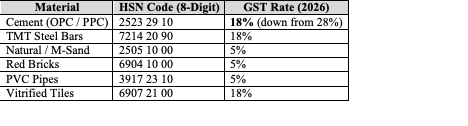
The big headline: Cement moved from the 28% "luxury" bracket down to the 18% "standard" bracket. For anyone building a home, that's a meaningful reduction in the overall cost of construction.
Why This Matters for You
Let's bring it home with three practical reasons.
1. No More Language Confusion
India has dozens of languages and hundreds of local names for building materials. Sand might be called "Bajri" in one state and "Reti" in another. But the HSN code 2505 means the same thing everywhere — from Kanyakumari to Kashmir. One code. One meaning. Zero confusion.
2. Protect Your Input Tax Credit (ITC)
This is where real money is at stake. As a builder, the GST you pay on materials can often be claimed back as Input Tax Credit. But there's a catch — your invoice must have a valid HSN code. If the code is wrong, the ITC claim gets rejected. Wrong code = lost money. It's that simple.
The Bottom Line
The shift to lower GST rates and high-tech E-Invoicing in 2025–2026 has made India's construction industry more transparent, more affordable, and more digital than ever before.
Looking for high-quality construction materials with verified HSN and GST compliance? Explore the full range at www.constromat.com.
Useful Government Resources
DGFT (Directorate General of Foreign Trade): Look up ITC-HS codes for any product https://www.dgft.gov.in/CP/?opt=itchs
Written by
Constromat
Expert contributor at ConstroMat, sharing insights on construction materials, industry trends, and best practices.
View all posts